OpenAI said in February 2026 that ChatGPT had passed 900 million weekly active users (TechCrunch, 27 February 2026). When those users ask who to hire, the assistant names a handful of businesses. Here are five common reasons brands are left out, and how generative engine optimisation (GEO) fixes them.
The Short Answer
Generative engine optimisation (GEO) is the work of making your business easy for AI assistants such as ChatGPT, Perplexity, Gemini and Google’s AI Overviews to find, trust and name in their answers. SEO earns you a place in a list of links; GEO earns you a sentence in the answer itself.
The audience is already there: OpenAI said in February 2026 that ChatGPT had passed 900 million weekly active users (TechCrunch, 27 February 2026). When one of them asks "which agency in Bangalore can run my Google Ads?", the assistant names a handful of businesses. If yours isn’t one of them, that enquiry is unlikely to reach your website, and that’s likely where leads are leaking.
These are the common reasons a brand is missing from AI answers:
1. AI search crawlers can’t read the site. ChatGPT search uses OpenAI’s OAI-SearchBot; if robots.txt or a firewall blocks it, your pages can’t appear in ChatGPT search results (OpenAI crawler documentation, accessed 2026).
2. The pages don’t answer the question directly. Assistants lift clear, self-contained answers; long intros and vague service pages give them nothing to quote.
3. There is no proof on the page. In the 2023 Princeton-led study GEO: Generative Engine Optimization (Aggarwal et al., arXiv 2311.09735), adding citations, quotations and statistics raised a page’s visibility in generative answers by up to 40% in the researchers’ tests.
4. Nobody else mentions you. Assistants lean on what other sites say: directories, reviews, press and partner pages. A brand that only talks about itself is easy to leave out.
5. Your details don’t match. Different names, addresses or service lists across your site, Google Business Profile and social profiles make it harder for an assistant to be sure who you are.
What to Expect
GEO is not a separate track from good SEO; most of the work improves your Google rankings, your social profiles and your AI answers together. What changes is what you check.
– Audit first: crawler access, the questions your buyers ask, and where you are named today. MK’s Growth Audit covers Google, social and AI answers in one report.
– Then the pages: rewriting key pages so each one answers one question clearly, adding sourced numbers and FAQs, fixing schema markup, and making your business details match everywhere.
– Then ongoing work: earning mentions on sites assistants trust, and tracking a fixed set of questions across ChatGPT, Perplexity, Gemini and AI Overviews every month, with the saved answer as proof. This sits inside MK’s SEO retainer, which includes GEO and AEO work.
An honest view: assistants change their answers often, so progress is measured over months, on the same questions, with dated screenshots. Any effect on leads and revenue is an estimate, and it depends on your market and the data you share with us. Anyone who promises a fixed position in ChatGPT is promising something nobody controls.
How MK Does It
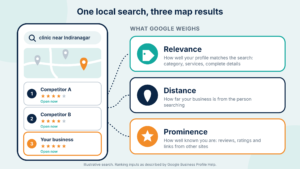
We start with the questions, not the keywords. For each client we write down 10 to 20 questions a real buyer would type into an assistant, such as "dermatologist near Indiranagar" or "who builds modular kitchens in HSR Layout", and record which businesses each engine names today. That saved answer is the baseline.
Then we work through the five causes above, ranked by their likely effect on leads and revenue: crawler access and robots.txt first, then page structure (one question, one direct answer, then the detail), then proof (sourced numbers, named methods, genuine reviews), then mentions on trusted third-party sites, then consistent business details across your site, Google Business Profile and social channels.
Every month we ask the same questions again and save each answer with the date, the engine and the exact wording. When an engine starts naming or linking to you, that saved answer is the proof in your report. We show our work.
Common Mistakes
- Blocking AI crawlers by accident. Security plugins and CDN bot rules can block OAI-SearchBot and similar crawlers. Check your robots.txt and firewall logs before anything else.
- Writing for robots instead of people. Keyword stuffing performed poorly in the 2023 GEO study’s tests, while clear writing with evidence did better (Aggarwal et al., 2023; summarised by Search Engine Journal).
- Chasing volume links. Mass, low-quality backlinks don’t earn trust from people or assistants. A few genuine mentions on respected sites do more.
- Measuring once. One screenshot of one answer proves nothing. Track a fixed set of questions on a fixed schedule.
- Treating GEO and SEO as rivals. The same clear, sourced, well-structured page tends to help in Google results, social discovery and AI answers.
Frequently Asked Questions
Is GEO different from SEO?
It builds on it. SEO helps your pages rank in search results; GEO helps AI assistants quote and name you in their answers. Most of the groundwork, such as fast pages, clear structure and trusted mentions, serves both.
Can I pay to appear in ChatGPT answers?
Not in ChatGPT’s organic answers. Being named depends on what the assistant can read about you and how well other sources back it up.
How do I check if ChatGPT knows my business?
Ask it the questions your customers would ask, in their words, and note whether you are named and whether your site is linked. Repeat the same questions each month and keep the answers.
How long does GEO take?
It varies by industry and competition. We fix access, pages and proof first, then review the first changes in AI answers with you once those fixes are live. Results vary by business and market.
What does MK need to start?
Access to your website, Google Search Console and Google Business Profile, plus 30 minutes to agree the questions we’ll track.