| Website traffic dropping usually traces to five causes: AI Overviews and other answer features absorbing clicks, a lower click-through rate on your listings, a Google core update, technical or indexing faults, and tracking errors. Check Search Console first. If impressions hold but clicks fall, suspect CTR or AI features before you blame rankings. |
Rankings Look Fine. So Why Did Clicks Fall?
Imagine the marketing manager of a software company in Whitefield. The rank report is green and several keywords moved up. Yet organic visits are down and the sales team is asking why. This is a made-up scenario, but it is the pattern behind many cases of website traffic dropping in 2026.
The good news is that a drop is a symptom, not a verdict. This guide for Bangalore businesses shows how to read the pattern, why you can see a traffic drop but rankings improving, and how to fix each of the five causes. It also covers the AI Overviews impact on clicks, using named studies and Google’s own documentation.
| Key takeaways A drop is a pattern to read, not a penalty. Impressions, clicks and position together point to the cause. Position and clicks can move in opposite directions. Position only says where you appear. Pew Research found a click on a result link in 8% of visits with an AI summary, against 15% without. Google says core update drops are broad reassessments, not penalties, and recovery can take months. Fix measurement and technical faults first. They are the cheapest causes to rule out. |
How Do You Find Out Why Your Website Traffic Is Dropping?
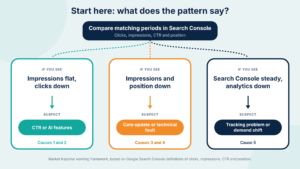
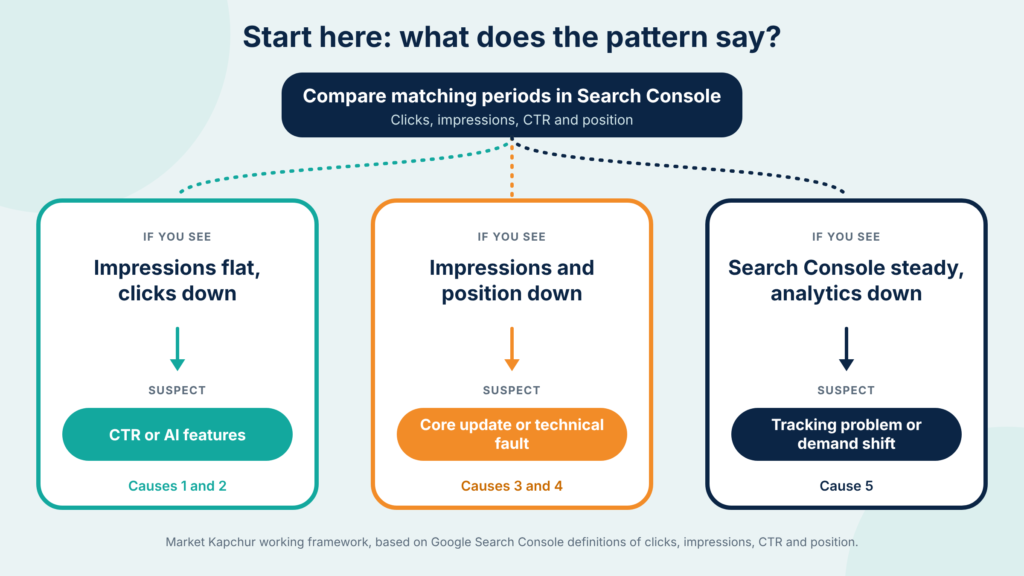
| Open Search Console and compare matching periods for clicks, impressions, click-through rate and position. Google defines CTR as clicks divided by impressions. Then match the pattern to a cause: flat impressions with fewer clicks points to CTR or AI features, falling impressions points to updates, demand or technical faults, and steady Search Console data points to tracking. |
| Pattern in Search Console | Likely cause | Check first |
| Impressions flat, clicks down, position steady | Lower CTR or AI features | Live results for your queries, then titles and snippets |
| Impressions and position both down | Core update or content quality | Update dates and your most affected pages |
| Sudden drop on specific pages | Technical fault | URL Inspection for indexing, redirects and canonicals |
| Impressions down, position steady | Lower demand or seasonality | Google Trends and last year’s same period |
| Search Console steady, analytics down | Tracking problem | Tags, consent settings and filters |
The table is our working framework, built from Google’s Search Console definitions. Use it to decide where to look, then confirm with the data.
Cause 1: How Is AI Overviews Impact Reducing Your Clicks?
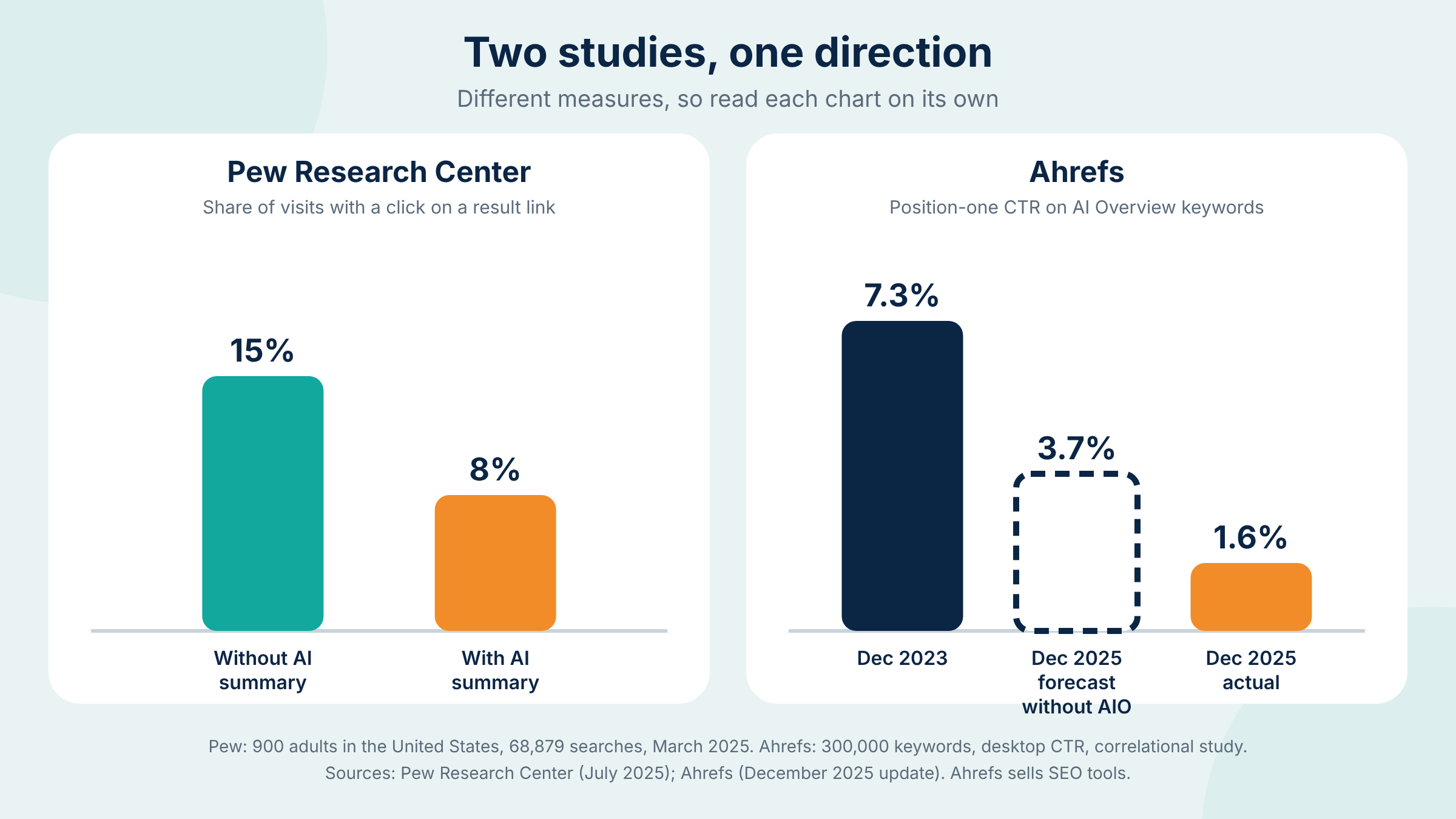
| When Google shows an AI Overview, fewer people click traditional results. Pew Research found a result click in 8% of visits with an AI summary against 15% without. Ahrefs found position-one CTR about 58% lower on AI Overview keywords in December 2025. The studies measure different things, so treat them as direction, not a forecast. |
| Source | What it found | Read it with this caveat |
| Pew Research Center (March 2025 data, published July 2025) | Users clicked a result link in 8% of visits with an AI summary and 15% without. About 1% clicked a link inside the summary. | Browsing panel of 900 adults in the United States and 68,879 searches. It measures behaviour, not site traffic. |
| Ahrefs (December 2025 update) | Position-one CTR on AI Overview keywords fell from 0.073 to 0.016, about 58% below a forecast of 0.037. | 300,000 keywords, desktop only and correlational. Ahrefs sells SEO tools. |
| Google Search Central | Says clicks from results pages with AI Overviews are “higher quality”, with users spending more time on the site. | Google gives no data to support it. |
Google also says AI Overviews and AI Mode traffic is included in the Web search type in the Performance report. Clicks on external links count as clicks, and an AI Overview occupies a single position that all its links share. So your reported position can look steady while clicks fall.
How to fix it
- Find the affected queries. Filter Search Console for queries with high impressions and a falling CTR, then view the live results to see if an AI Overview appears.
- Add what a summary cannot. Original data, local experience, tools, calculators and named expertise give people a reason to click.
- Write answer-first. Short, direct answers with clear headings make your page easier to cite. Our guide to building brand authority in AI Overviews and ChatGPT results explains the approach.
- Judge by enquiries. If leads held while informational clicks fell, the lost visits may have been low intent.
- Get help where it counts. Our GEO services in Bangalore cover AI search visibility for brands that need to be cited, not just ranked.
Cause 2: Traffic Drop but Rankings Improving? Look at CTR
| Rankings and clicks can move in opposite directions because position only shows where you appear, not how many people click. Search Console CTR is clicks divided by impressions, so crowded results, AI features, ads and weak titles can lower CTR even when position improves. Compare CTR by query before you blame rankings. |
- Crowded results: AI Overviews, featured snippets, People also ask boxes, ads, video and map results can sit above your listing.
- Stale snippets: competitors rewrite titles and descriptions while yours stay unchanged.
- Averages hide losers: Google reports average position across queries, so a few big queries can fall while the average improves.
- Local searches: for “near me” queries in Bangalore, map results and Business Profiles can appear above organic listings.
How to fix it
- Export queries with impressions above your site’s median and CTR below it, then review those titles first.
- Rewrite titles and descriptions to match the search intent and promise something specific.
- Change one thing at a time on a page, then wait before judging the result.
- Strengthen your key pages. Our guide to optimizing your homepage for SEO and AEO shows how to structure the page that carries most of your brand queries.
Cause 3: Did a Google Core Update Hit Your Traffic?
| Google makes several broad core updates a year, and a drop that lines up with one is a reassessment of content, not a penalty. Google advises waiting until the rollout finishes, then comparing the week after with the week before. The March 2026 update ran from March 27 to April 8, and the May 2026 update began on May 21. |
- Check the dates on the Google Search Status Dashboard and compare your top pages and queries across the update.
- Read the size of the drop. Google says a small position change of 2 to 4 needs no drastic action, while a large drop deserves a deeper review.
- Assess your content against Google’s helpful, reliable, people-first guidance, ideally with outside reviewers.
- Avoid quick fixes. Google says to improve content in ways that help users and to delete content only as a last resort.
- Plan for months. Google says its systems may need several months to confirm sustained improvement.
Cause 4: Are Technical Faults Causing the Drop?
| Sudden drops on specific pages often trace to technical changes: an accidental noindex tag, a robots.txt block, broken redirects after a redesign or a changed canonical. Google states a page must be indexed and eligible to show with a snippet to appear in Search at all. Run URL Inspection on the pages that lost traffic first. |
- Indexing: check the Page indexing report for new exclusions and errors.
- Redirects: after a redesign, confirm every old URL points to its closest new page.
- Directives: look for stray noindex tags, blocked folders and changed canonicals.
- Speed and errors: watch server errors and slow templates on high-traffic pages.
Traffic can fall after a relaunch if URLs change, so migration planning should be part of any rebuild. If a redesign is on your roadmap, talk to a team that handles web development in Bangalore with SEO in the brief, so URLs and redirects are mapped before launch.
Cause 5: Is It a Tracking Problem or a Demand Shift?
| Not every drop is real. A broken analytics tag, a consent banner change or a new filter can undercount organic visits, and falling search demand lowers impressions with no ranking change. Check whether Search Console clicks fell too. If they did not, fix measurement before you change your SEO. |
- Compare sources: put Search Console clicks next to analytics organic sessions for the same dates.
- Audit after releases: check tags, events and consent settings after any site or tool change.
- Check demand: use Google Trends for your main topics to see if interest fell.
- Compare year on year: festival periods such as Diwali and Ugadi can swing demand in Bangalore, so month on month can mislead.
How Do You Know the Fix Is Working?
| Track recovery with the same metrics that showed the drop: clicks, impressions, CTR and position for the affected queries, plus enquiries from organic. Review them weekly for patterns and monthly for decisions. Google says some changes take effect within days, but others take months, so avoid reversing a good fix too early. |
- Search Console: clicks, impressions and CTR for the query and page groups you changed.
- Branded versus non-branded: separate people who know you from people discovering you.
- Business outcomes: form fills, calls and WhatsApp enquiries from organic.
- AI visibility: note whether your brand is cited in AI answers for your key questions.
Where to Start: A Simple Rule for Traffic Drops
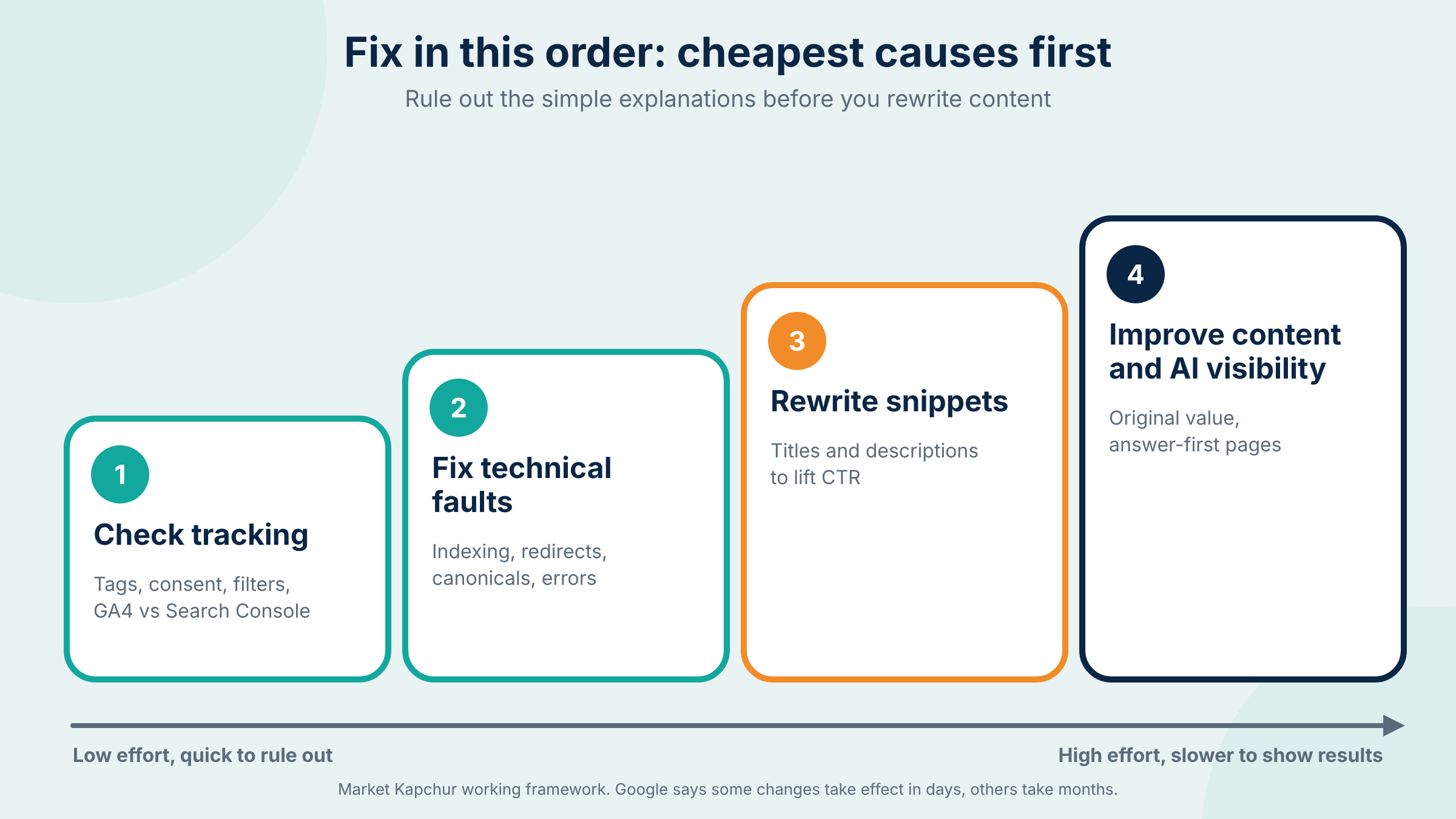
| Diagnose before you fix. Match impressions, clicks and position to a cause, change one thing at a time and judge success by enquiries, not clicks alone. If clicks fell but leads held, low-intent visits may simply have left. Fix what the data shows, in order of cost: tracking, technical, snippets, content. |
If website traffic dropping is hard to explain, Market Kapchur’s Bangalore team starts with an audit of Search Console, technical health and AI search visibility before recommending changes. We can show which cause applies, but we cannot promise a ranking or a recovery date. For a wider view of what is working now, see the latest SEO strategies for 2026 and 2027.
| Not sure which cause is behind your drop? Share your Search Console screenshots and your top pages, and an expert will help you read them. Get My Proposal or call +91 6364905511. |
Frequently Asked Questions
Is a traffic drop always bad for business?
No. Check enquiries before you react. If clicks fell on informational queries but calls, forms and WhatsApp leads held, the lost visits may have been low intent. A drop matters when it hits pages that bring leads or sales, so tie every traffic number to a business outcome.
Can I stop my content appearing in AI Overviews?
You can limit what Google shows, but there is a trade-off. Google says nosnippet, data-nosnippet, max-snippet and noindex controls limit what Search shows from your pages. Google-Extended limits AI training and grounding in some other systems. Test changes with URL Inspection, because recrawling can take days to months.
Does Search Console show AI Overview traffic separately?
Not as a separate line item. Google says AI Overviews and AI Mode traffic is included in the Web search type in the Performance report. Clicks on external links count as clicks, and an AI Overview takes a single position shared by its links. Use query-level CTR and live checks to spot the effect.
Should I stop writing informational content?
Not automatically. Check which informational pages still lead to enquiries, newsletter signups or branded searches. Keep and improve those. For pages that only lose clicks, add original data, local expertise or tools, or shift effort toward topics closer to a buying decision. Decide page by page, not across the whole site.
Which tools do I need to diagnose a traffic drop?
Free tools cover most cases. Use Search Console for clicks, impressions, CTR and URL Inspection, an analytics tool for sessions and conversions, and Google Trends for demand. Add manual searches or screenshots to see what appears above you. A rank tracker helps, but it cannot explain CTR on its own.
Sources
Pew Research Center, Google users are less likely to click on links when an AI summary appears in the results (click rates with and without AI summaries)
Ahrefs, AI Overviews reduce clicks (update) (position-one CTR on AI Overview keywords, December 2025)
Google Search Central, AI features and your website (Search Console reporting, eligibility and snippet controls)
Google Search Central, Core updates (how to assess an update and recovery timing)
Google Search Console Help, Performance report (definitions of clicks, impressions, CTR and position, and AI feature counting)
Search Engine Journal, core update rollout coverage (March and May 2026 core update dates)