The latest SEO strategies to rank on Google in 2026 and 2027 focus on four things: building topical authority, proving real-world experience through E-E-A-T, earning citations in AI Overviews and AI assistants, and delivering responsive pages that pass Interaction to Next Paint (INP). Pairing organic SEO with paid search data helps you move faster as click patterns change.
How Google Search Has Changed in 2026
“Ranking on Google” no longer means only earning a blue link. With AI Overviews and AI Mode now built into search, many users get answers directly on the results page, while others ask ChatGPT, Perplexity, or Gemini instead. Success now depends on satisfying human intent while making your content easy for search engines and AI systems to understand and cite.
As a search engine optimization company in Bangalore, we’ve watched this shift reshape results for local businesses over the past two years. The advanced SEO strategies in this guide build on three pillars of modern discovery:
- Entity-based authority: Ranking for topics, concepts, and brand reputation rather than isolated keyword strings.
- Verified experience: Offering first-hand insights that AI models can’t synthesize from existing public content.
- Multimodal visibility: Making images, video, and spoken answers discoverable through Google Lens and voice search.
Traditional SEO vs. Modern SEO
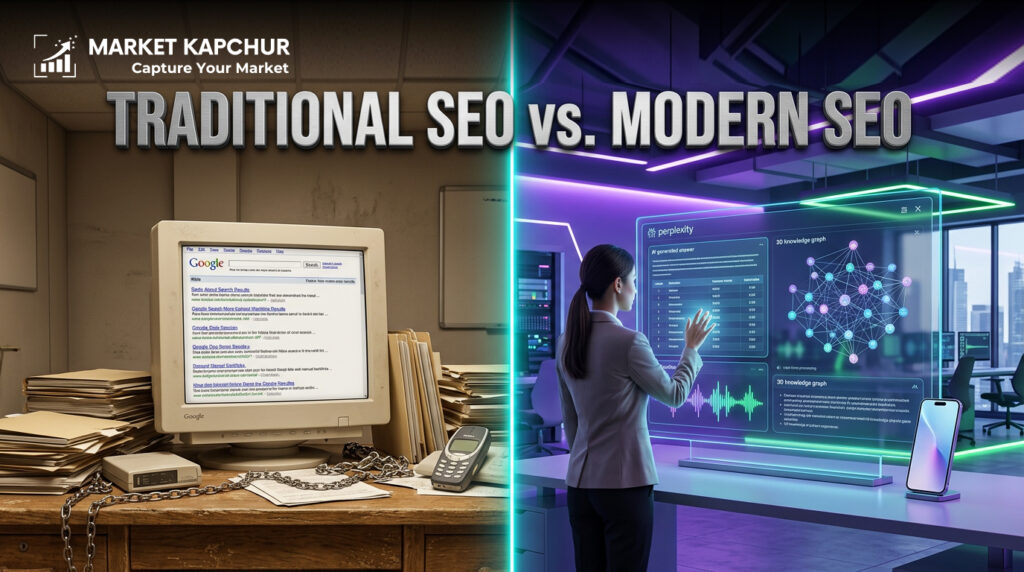
The shift from Traditional SEO to Modern SEO marks a transition from manipulating search engine algorithms to optimizing for human intent and AI-driven understanding.
| Optimization Category | Traditional SEO (The Old Way) | Modern SEO (The 2026–2027 Way) |
| Primary Focus | Search Engine Algorithms: Writing content primarily to satisfy automated crawlers, bots, and ranking math. | User Experience & AI: Designing content that satisfies the human user while matching AI-driven semantic search models. |
| Keyword Strategy | Exact-Match & Volume: Targeting specific, high-volume keywords and repeating them exactly throughout the text. | Intent & Entities: Targeting conversational, long-tail queries and building structural topical authority around concepts. |
| Content Creation | Mass Production: Creating high quantities of short, generic pages to capture broad keyword variations. | Radical E-E-A-T: Publishing deep, authoritative content backed by original data, first-hand human experience, and expert insights. |
| Link Building | Quantity & Anchors: Acquiring a high volume of backlinks using exact-match anchor text to pass “PageRank.” | Digital PR & Authority: Earning natural brand citations, entity mentions, and high-trust contextual links across the web. |
| Technical Focus | Basic Indexation: Checking basic sitemaps, robots.txt files, and ensuring pages could simply be crawled. | Page Experience: Optimizing core web vitals, instant mobile rendering, structured data schemas, and AI-crawler accessibility. |
| Success Metrics | Rankings & Clicks: Tracking specific keyword positions on page one and total organic click-through rates. | Engagement & Ecosystem: Measuring average engagement time, scroll depth, branded search growth, and AI overview visibility. |
Key Structural Differences
Keyword Matching vs. Topical Clusters
- Traditional: Focuses on single keywords per page (e.g., “best running shoes”), leading to thin, repetitive content across multiple URLs.
- Modern: Groups content into hierarchical hubs (Pillar and Cluster pages) to cover a broad subject thoroughly and capture hundreds of related conversational queries on one authoritative page.
Text Matching vs. Semantic AI Understanding
- Traditional: Relied heavily on keyword density percentages to signal relevancy to search bots.
- Modern: Leverages natural language processing models. Google understands context, synonyms, and the underlying intent behind a user’s query, making keyword stuffing obsolete.
Desktop First vs. Omnichannel Experience
- Traditional: Optimized web layouts heavily for desktop screens, treating mobile design as a secondary checkbox.
- Modern: prioritizes mobile-first performance, seamless page layouts, fast interactive speeds, and optimization for voice search and generative AI engines.
6 Latest SEO Strategies to Rank on Google in 2026–2027
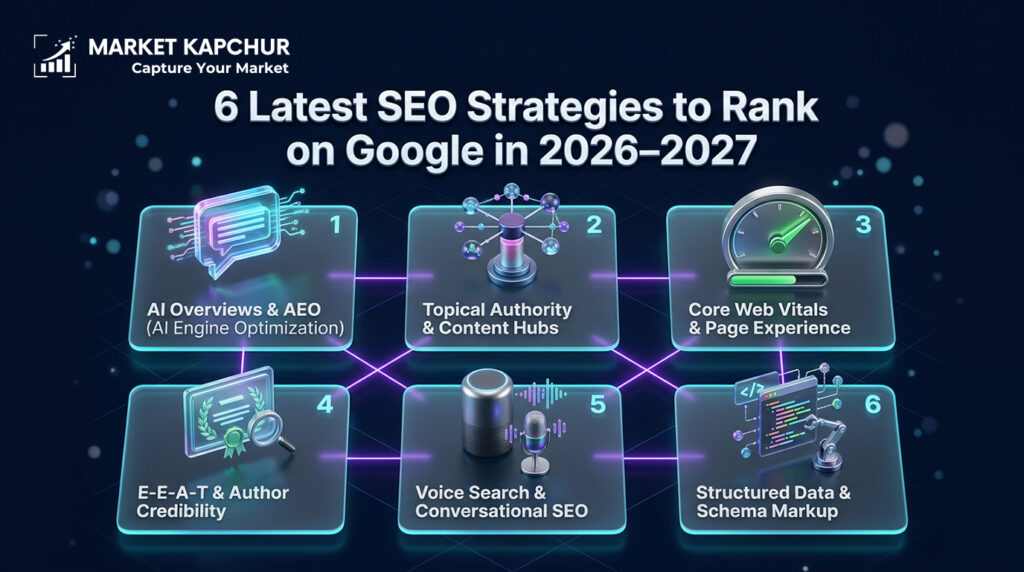
1. Optimize for AI Overviews & Answer Engines (AEO)
- Structure pages for machine readability so AI Overviews and LLMs can cite you directly
- Add a concise 40 to 60 word answer summary right under your primary heading
- Use clean H2/H3 hierarchies formatted as question-and-answer pairs
- Host an llms.txt file at your site root as a roadmap for AI crawlers
- Check robots.txt allows AI search crawlers like OAI-Search Bot and Perplexity Bot (separate from GPT Bot, which trains models, not search citations)
2. Search Everywhere: Diversify Beyond Google
- Build organic presence on YouTube, Reddit, TikTok, LinkedIn, and Amazon, not just Google
- Use YouTube’s indexability to build video funnels that route viewers back to your site
- Track how social and video content gets indexed via Google Search Console’s reporting tools
3. Build Topical Authority with Entity Clustering
- Map a core topic into a cluster of related subtopics and long-tail questions
- Build pillar pages that link to supporting cluster content with descriptive anchor text
- Run regular content gap audits against your top 4-5 competitors to spot missing subtopics
4. Create an Original Content Moat (E-E-A-T)
- Publish proprietary data, original case studies, and research that AI models can’t replicate
- Show real author credentials, expert quotes, and citations to authoritative sources
- Use original photos and custom video instead of stock imagery to build trust
- Bangalore example: a Koramangala dermatology clinic added first-person doctor insights and patient-consented videos, Share of Local Voice rose 40% in 6 months (measured via Local Falcon)
Case study: A dermatology clinic in Koramangala had underperforming treatment pages. We rewrote them with first-person doctor insights, added patient-consented journey videos, and updated the clinic’s Google Business Profile. Over six months, their Share of Local Voice (SoLV), measured in Local Falcon, rose 40%. This suggests Google’s systems reward localized, expert-led content in sensitive categories.
Running a clinic or service business? Book a local SEO consultation and we’ll show you where your Google Business Profile and service pages are losing visibility.
5. Advanced Schema & Core Web Vitals
- Deploy FAQ, HowTo, Product, LocalBusiness, and Organization schema across pages
- Keep mobile load times under 3 seconds
- Maintain clean site architecture, HTTPS, and updated XML sitemaps
- Prioritize INP: 200ms or less is “Good” per web.dev, above 500ms is “Poor”
6. Target Bottom-of-Funnel Intent Over Volume
- Group keywords by commercial/transactional intent, not raw search volume
- Match page format to intent: comparison tables, calculators, or deep-dive product pages
- Build detailed FAQ modules addressing late-stage buyer objections
- Use paid search data (ad headline CTR, Search Terms report) to find winning angles, then apply to organic
How to Measure SEO Success Beyond the Click
As AI answers satisfy more queries on the results page, traffic alone no longer shows whether your advanced SEO strategies are working. Today, we track:
Leads & Conversions — form fills, calls, and chat inquiries from organic search
ROI — cost per organic lead vs paid, revenue attributed to organic channel
Rankings & Keywords with Intent — track by funnel stage, not just position
AI Visibility — brand mentions in AI Overviews and assistants (Semrush, Ahrefs Brand Radar)
Page Loading — Core Web Vitals, especially INP
Technical Health — crawl errors, indexation coverage, structured data validation
Freshness & Trends — content update cadence, alignment with algorithm updates, emerging query trends
Conclusion: Build Trust, Not Just Traffic
The latest SEO strategies share one principle: Google and AI systems reward brands that are genuinely helpful, technically sound, and clearly trustworthy. By combining verified experience, strong local signals, responsive pages, and a smart mix of organic and paid search, your business can stay visible however search evolves.
Putting these advanced SEO strategies into practice takes time and expertise, and choosing the right search engine optimization company in Bangalore can shorten that journey considerably. Talk to our Bangalore SEO team to build a discovery strategy tailored to your market, neighbourhood, and goals.
Frequently Asked Questions
How do I optimize for Google AI Overviews?
Google says there are no special requirements for AI Overviews beyond standard SEO best practices. Focus on helpful, well-structured content with clear H2 and H3 headings, concise summaries near the top of each section, and structured data that matches what’s visible on the page.
Is backlink building still effective in 2026 and 2027?
Yes, but quality matters far more than volume. A link or mention from a relevant local news outlet or niche industry publication carries more weight than dozens of low-authority directory links. Earning links through original research and data is the most sustainable approach.
What is a good INP score?
A “Good” INP score is 200 milliseconds or less at the 75th percentile of real-user data. Scores between 200ms and 500ms “Need Improvement,” and anything above 500ms is “Poor.” Auditing JavaScript execution is usually the fastest way to improve it.
How is AI changing keyword research?
Keyword research has shifted from single phrases to topical authority built through topic clusters. Instead of targeting one keyword per page, map out an entire topic, answer the “why” and “how” behind each query, and verify your site in Google Search Console and Bing Webmaster Tools so it’s indexed by both engines.
Will AI-generated content get my site penalized?
Google rewards helpful content regardless of how it’s created. AI can speed up drafting, but every piece should be enriched with original data, examples, and expert insight. That’s what satisfies the “Experience” component of E-E-A-T and separates your brand from generic content.
How can paid search data improve organic rankings?
Paid search shows you which headlines and queries actually drive clicks and conversions. Use winning ad copy to refine your organic title tags, and mine the Google Ads Search Terms report for converting queries to target with new content.
How do I choose the right search engine optimization company in Bangalore?
Look for an agency that shares real case studies with measurable results, explains its methods transparently, and understands both local search and AI-driven discovery. Avoid anyone promising guaranteed #1 rankings. If you’d like to see how we work, schedule a consultation with our team.