Many business owners investing in SEO services in Bangalore face a frustrating paradox: their monthly reports show green checkmarks and rising keyword counts, but their phone isn’t ringing with actual sales leads.
The digital landscape completely shifted between 2024 and 2026. Search engines evolved from simple keyword-matching systems into highly sophisticated, semantic AI engines. If your digital marketing agency is still using legacy optimization playbooks, they are actively draining your marketing budget on metrics that no longer move the needle.
As the best SEO services agency in Bangalore, designs performance-led frameworks engineered for how search algorithms function today.
This case study highlights three major red flags that indicate an SEO provider may still be relying on outdated tactics and explains what modern optimization looks like today.
3 Signs Your current SEO services strategies are outdated:
Sign #1: They Focus on Keyword Density Instead of Entity-Based Semantic Clusters
One of the first signs of outdated SEO is an excessive focus on keyword density.
If an agency insists on writing clunky, repetitive phrases simply to reach an exact keyword percentage, it may be optimizing for an outdated algorithm. Search engines and Large Language Models (LLMs) now process content contextually through entity recognition and passage-level tracking.
Modern SEO requires a different approach—one that focuses on building meaningful topical relevance instead of simply repeating exact-match keywords.
The 2024 Mistake
A common outdated approach is creating separate, thin 500-word articles for minor keyword variations such as:
- “SEO Company in Bangalore”
- “SEO Services in Bangalore”
The objective of this approach is to manipulate search crawlers by creating multiple pieces of content around closely related keyword variations.
The 2026 Strategy
The modern strategy is to build comprehensive and authoritative topic hubs that satisfy Google’s strict E-E-A-T (Experience, Expertise, Authoritativeness, Trustworthiness) guidelines.
Content needs to demonstrate:
- Genuine human experience
- Industry expertise
- Factual layering
- Strong topical authority
This approach is designed to help content survive modern core updates rather than relying on keyword repetition.
Sign #2: They Are Completely Ignoring AI Overviews (SGE) and GEO
Traditional organic listings are no longer the exclusive gateway to web traffic.
Conversational search engines such as ChatGPT Search, Gemini, Perplexity, and Google’s AI Overviews routinely capture user attention before users ever click a standard search result.
This creates a major disconnect for businesses whose SEO strategy focuses only on traditional organic rankings.
The AI Search Disconnect
If your current digital marketing partner is not optimizing your website for Generative Engine Optimization (GEO) and Answer Engine Optimization (AEO), your brand may be invisible to a significant segment of your target market.
The 2026 Shift
The source data states that over 60% of commercial search queries now trigger an automated AI summary or conversational answer box right at the top.
If a brand is not explicitly cited as a trusted source within that AI synthesis, it can miss out on high-intent buyers online.
This means modern SEO needs to consider not only traditional search visibility but also how content is understood, synthesized, and presented through AI-driven search experiences.
Sign #3: Relying on Bulk Link-Building Over Local Authority Architecture
Another major warning sign is dependence on bulk link-building.
Low-cost SEO packages often rely on automated, bulk backlink syndication to demonstrate artificial progress. In 2026, search algorithms can identify and penalize these low-quality link networks.
True authority cannot be bought through bulk package deals.
Instead, it needs to be built through:
- Authentic local citation relevance
- Hyper-localized schema markup
- Fast technical architecture
- Clean, targeted location landing pages
This represents a shift away from simply measuring the quantity of backlinks toward developing genuine local authority and a technically strong website structure.
Legacy Optimization vs. Next-Gen Visibility
The difference between outdated SEO and the modern Market Kapchur workflow can be summarized through four major areas:
| 2024 Legacy Playbook (Outdated) | 2026 Next-Gen Strategy (Market Kapchur Workflow) |
| Exact-match keyword stuffing | Passage-level optimization & topical authority |
| Chasing generic organic clicks | Optimizing for AI Overviews, GEO, and Conversational Search |
| Bulk, automated spam backlink bundles | E-E-A-T signaling, hyper-local schema, and clean tech structures |
| Volume-focused reports (Rankings only) | Performance-focused analytics (Qualified leads & revenue tracking) |
The difference is not simply about changing keywords or producing more content. It is about changing the way search visibility is approached, measured, and connected to business performance.
Why Market Kapchur Is the Best SEO Service Provider in Bangalore

Market Kapchur does not run on blind guesswork or generic templates.
The company stands out as the best SEO service provider in Bangalore because it ties search visibility directly to transparent, measurable client growth.
Its strategies are grounded in:
- Rigorous data
- Technical depth
- Modern E-E-A-T standards
- Performance-focused analytics
- Local authority architecture
- User-intent matching
The focus is on the technical and structural indicators that search engines prioritize, rather than simply reporting rankings or traffic volumes.
The following real-world campaign data demonstrates how this approach translated into measurable organic search growth for Insta Automations.
Case Study: Insta Automations Organic Growth
January 2026 vs. July 2026
Market Kapchur tracked the organic search evolution of its client, Insta Automations, from the start of the year to July 2026.
The campaign demonstrates the changes achieved after optimization across organic clicks, search impressions, click-through rate, and average position.
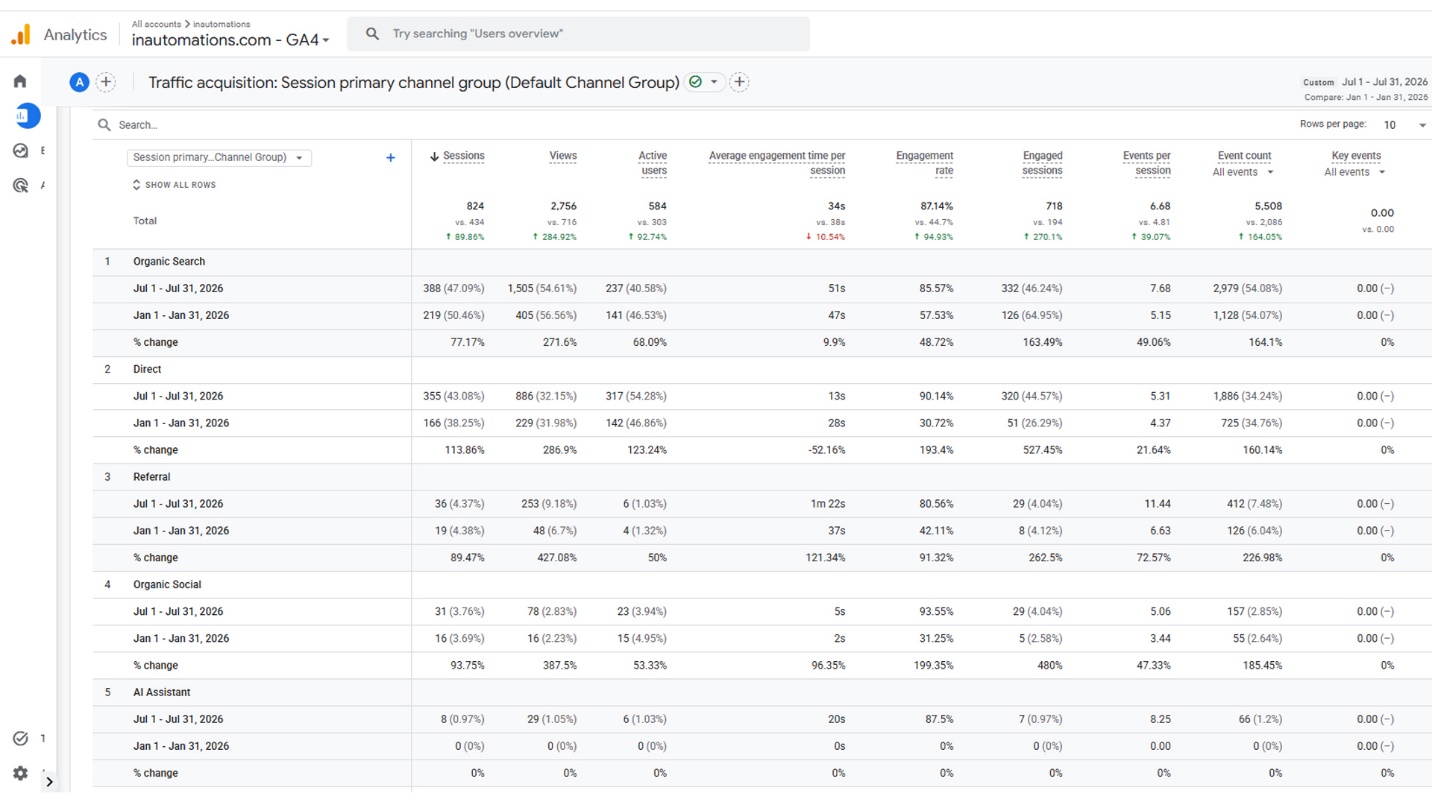
Performance Results
| Performance Metric | January 2026 (Baseline) | July 2026 (After Optimization) | Net Improvement |
| Organic Clicks | 100 clicks | 217 clicks | +117% Growth |
| Search Impressions | 8.1 impressions | 13,000 impressions | +62.5% Visibility |
| Click-Through Rate (CTR) | 0.4% CTR | 1.7% CTR | +325% Efficiency |
| Average Position | 30.2 | 16 | Climbed 14 positions |
These results show significant movement across the key organic search performance indicators tracked in the campaign.
- Organic clicks increased from 100 to 217, representing +117% growth.
- Search impressions moved from 8.1 impressions to 13,000 impressions, representing +62.5% visibility.
- Click-through rate improved from 0.4% to 1.7%, representing +325% efficiency.
- Average position improved from 30.2 to 16, representing a climb of 14 positions.
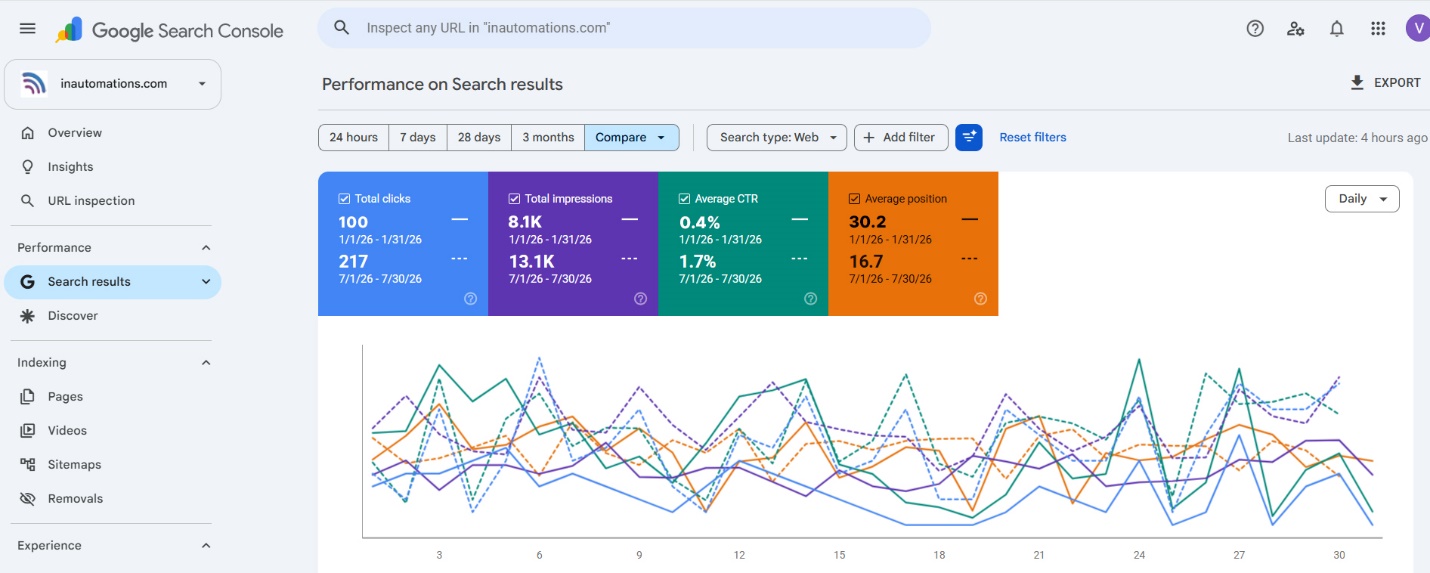
What Changed Through the Optimization?
The case study attributes the improvement to redesigning the local authority architecture and matching user intent precisely.
Through this approach, Market Kapchur more than doubled the organic traffic of Insta Automations and fundamentally improved its search positioning in six months.
The focus was placed on the exact technical and structural indicators that search engines prioritize.
The objective was not simply to increase visible rankings. The approach focused on turning an invisible website into a market leader through performance-led search optimization.
What This Case Study Shows
The Insta Automations campaign demonstrates the difference between reporting SEO activity and measuring actual SEO performance.
The campaign tracked four important performance metrics:
- Organic Clicks — increased from 100 clicks to 217 clicks.
- Search Impressions — increased from 8.1 impressions to 13,000 impressions.
- CTR — improved from 0.4% to 1.7%.
- Average Position — improved from 30.2 to 16.
The case study therefore connects SEO optimization with measurable changes in search visibility, click efficiency, organic traffic, and search positioning.
Conclusion: Stop Paying for Last Year’s Tactics

SEO has moved beyond simply targeting keywords, generating backlinks, and reporting ranking positions.
The difference between the 2024 legacy playbook and the 2026 next-generation strategy lies in how websites build authority, structure content, address user intent, prepare for AI-driven search, and measure performance.
The Insta Automations case study provides a clear example of this shift. From January 2026 to July 2026, organic clicks increased from 100 to 217, CTR improved from 0.4% to 1.7%, and average position improved from 30.2 to 16.
Market Kapchur focuses on transparent, research-backed optimization designed around the way search algorithms function today.
Businesses should not settle for hollow traffic metrics that fail to generate revenue. A transparent assessment can help identify the true state of a website’s online footprint.
Get Your Free Website & AI Visibility Audit
Contact Market Kapchur today for a Free Website & AI Visibility Audit.
The optimization specialists will evaluate where your business stands in:
- Conversational AI summaries
- Local map packs
- Traditional search positions
Contact Market Kapchur
Call: +91 6364905511 Email: contact@marketkapchur.com Office: HBR Layout, Bangalore, India
Frequently Asked Questions
How do I know if my SEO agency is using black-hat methods?
If your provider promises overnight #1 rankings or shows reports packed with thousands of links from unrelated web domains, they are using automated spam. This places your website at high risk for permanent search engine penalties.
What is Generative Engine Optimization (GEO) in SEO?
GEO is the process of formatting your website’s copy, schema data, and factual layers so that AI search engines (like ChatGPT Search and Google AI Overviews) can easily understand, synthesize, and cite your brand as an industry recommendation.
Why is bulk link-building an outdated SEO tactic?
Low-cost SEO packages often rely on automated, bulk backlink syndication to show artificial progress. True authority is built through authentic local citation relevance, hyper-localized schema markup, fast technical architecture, and clean, targeted location landing pages.
What is the difference between traditional SEO and next-generation SEO?
Traditional SEO focuses on exact-match keyword stuffing, generic organic clicks, bulk automated backlink bundles, and ranking-only reports. Next-generation SEO focuses on passage-level optimization, topical authority, AI Overviews, GEO, conversational search, E-E-A-T signaling, hyper-local schema, clean technical structures, qualified leads, and revenue tracking.
How did Market Kapchur improve Insta Automations’ organic search performance?
Market Kapchur redesigned Insta Automations’ local authority architecture and precisely matched user intent. From January 2026 to July 2026, organic clicks increased from 100 to 217, CTR improved from 0.4% to 1.7%, and average position improved from 30.2 to 16.